

Why manual work still shapes core banking operations
Despite years of investment in digital transformation, manual processing continues to shape how many banks actually operate. Behind modern user interfaces and digital channels, critical core banking processes still depend on spreadsheets, email approvals, offline calculations, and undocumented exceptions. These elements rarely appear in official process diagrams, yet they remain central to daily operations.
Manual work does not exist because banks resist change. It exists because systems have historically struggled to keep pace with business reality. Products evolve, regulations change, and operational complexity increases faster than legacy core banking platforms can adapt. In response, teams introduce manual steps to bridge the gaps. Over time, these steps stop being temporary fixes and become embedded into the operational fabric of the institution.
What emerges is a parallel operating model, one that functions outside the core banking software and relies heavily on human coordination. This model may work under stable conditions, but it becomes increasingly fragile as volumes grow, teams expand, and regulatory scrutiny intensifies. This is closely aligned with the findings highlighted in the KPMG Banking Survey 2025, which emphasizes the growing need for stronger operational discipline and measurable value from technology investments across core operations.
The hidden cost of manual processing
The true cost of manual processing is not limited to inefficiency or delays. The deeper issue is the loss of traceability. When decisions are made outside the system, when approvals are exchanged informally, and when calculations are performed offline, the core banking software no longer reflects how the bank truly operates.
This disconnect creates blind spots. When auditors or regulators ask how a transaction was approved or why an exception was granted, the answer often depends on reconstructing events after the fact. Emails are searched, spreadsheets are reviewed, and individuals are asked to recall decisions made weeks or months earlier. The process is slow, error-prone, and increasingly unacceptable.
As institutions scale, these weaknesses become more pronounced. Manual controls that once seemed manageable begin to break down under pressure. Operational knowledge becomes concentrated in a small number of individuals, creating dependency risks that are difficult to mitigate. This mirrors the direction highlighted in the PwC Global Banking Risk Study 2025, which points to the industry’s need to move away from fragmented, manual, human-dependent processes toward more structured, technology-enabled operating models.
Why task automation alone is not enough
In an effort to reduce manual effort, many banks introduce automation initiatives, often through integrations, external tools, or workflow components that speed up specific steps. Done well, this can absolutely improve efficiency and connect the core to a wider ecosystem.
The challenge appears when automation is implemented as a set of disconnected “quick wins” around the core banking software, without consistent rules, shared context, and a traceable audit trail. Processes can become fragmented across systems, each with its own logic, logs, and limitations. Visibility improves in one area while being lost in another, and it becomes harder to explain how a decision was made across the full lifecycle of a product or customer.
This is why the goal is not to avoid integrations, but to ensure that automation remains governed and end-to-end traceable, with the core banking system acting as the operational source of truth. It is a reminder often echoed in industry outlooks, including EY’s Global Banking Outlook 2025, that sustainable progress comes from rethinking processes end to end, not just accelerating isolated steps.

Traceable automation starts inside the core
Traceable automation requires a shift in how banks think about their core banking software. Instead of viewing the core as a transaction processor, it must be treated as the system that orchestrates operational processes.
When workflows are embedded directly into the core, execution follows defined rules rather than informal practices. Approvals are enforced by system logic. Exceptions are handled transparently. Every action is recorded in context, creating a continuous operational history that reflects how the bank actually operates.
This approach restores the role of the core banking system as the single source of operational truth. Rather than reconstructing events after they occur, the system captures decisions as they happen.
How Aspekt Product Suite enables traceable automation
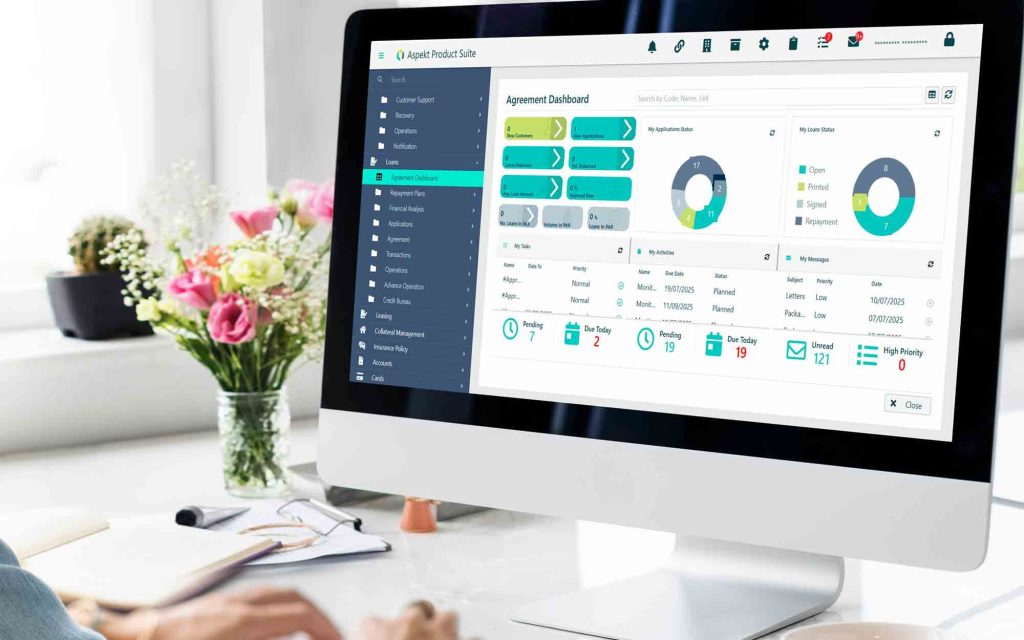
Aspekt Product Suite is designed around the principle that core banking software should support both execution and accountability. Its architecture embeds workflows directly into core operations, eliminating the need for external coordination and manual handoffs.
Processes such as lending, accounting, and servicing are governed by system-defined logic rather than personal interpretation. User actions are role-based, approvals are structured, and deviations are captured within the same system that processes transactions.
This design reduces reliance on spreadsheets and email-based approvals, replacing them with transparent, repeatable workflows. Traceability is built into everyday operations, making audit trails a natural by-product of normal system use rather than a separate reporting effort.
By consolidating automation within the core, Aspekt Product Suite helps banks maintain consistency across branches and teams, even as volumes increase and organizational structures evolve.
Operational discipline as a strategic advantage
Industry research increasingly highlights operational discipline as a key differentiator for banks navigating complexity and regulatory pressure. Institutions are being asked not only to demonstrate compliance, but to prove that their processes are controlled, repeatable, and resilient.
Traceable automation supports this shift by making operations visible and measurable. Management gains clearer insight into process performance. Compliance teams spend less time gathering evidence. Front-office and back-office teams benefit from predictable workflows that reduce rework and uncertainty.
Rather than slowing the organization down, structured automation creates confidence. Decisions can be made faster because they are supported by clear rules and documented outcomes.
From manual effort to operational confidence
The transition from manual processing to traceable automation is not about removing people from the process. It is about placing human judgment within a structured framework that supports accountability.
When processes are embedded in core banking software, judgment is applied consistently and transparently. This reduces friction between teams, strengthens internal controls, and improves the institution’s ability to respond to change.
In an environment where expectations continue to rise, traceability is no longer optional. It is becoming a baseline requirement for modern banking operations. For institutions looking to move from manual effort to operational confidence, Aspekt Product Suite provides a core banking foundation built for controlled, traceable automation. To explore how this can work in practice, contact us at sales@aspekt.mk.